


Contents hide 1 What Is a Lab-Made Restoration and How Does It Rebuild a Tooth? 2 What Is the Difference Between the Two Types? 3 How Is This Differen
Inlays and Onlays in Guiseley: A Tooth-Preserving Way to Restore Damaged Teeth
10th Nov 2026
Contents
hide
Inlays and onlays in Guiseley are custom-made restorations used to repair a tooth that is too damaged for an ordinary filling but not damaged enough to need a full crown. They are made in a dental laboratory from a scan of your tooth and then bonded into place, which gives a stronger, longer-lasting and better-fitting result than a large direct filling. An inlay sits within the biting surface of the tooth, while an onlay also covers one or more of the raised points, known as cusps. At One Two Three Dental, they preserve more of your natural tooth than a crown and are fitted over two short appointments.
What Is a Lab-Made Restoration and How Does It Rebuild a Tooth?
A lab-made restoration is a solid, custom-shaped piece that rebuilds the damaged part of a tooth. Unlike a filling that is moulded in the mouth, it is made in a dental laboratory from an exact scan of your tooth, then bonded firmly into place. This is known as an indirect restoration.
The word indirect is the key to understanding this treatment. A standard white filling is a direct restoration, meaning the soft material is placed into the tooth and shaped by the dentist in a single visit before it sets. An inlay or onlay is different. The restoration is manufactured outside the mouth to precise measurements and then fixed to the tooth with a strong adhesive resin cement. Because it is made under laboratory conditions rather than shaped by hand inside a small, wet space, it fits the tooth more accurately and is more resistant to wear.
This precise fit matters clinically. A better seal at the join between the restoration and the tooth means less chance of bacteria leaking underneath, which is a common reason large fillings eventually fail. An inlay or onlay effectively becomes a tailored, solid replacement for the missing part of the tooth, restoring its shape, strength and biting surface.
What Is the Difference Between the Two Types?
The difference is how much of the tooth they cover. An inlay fits within the central biting surface of the tooth, between the raised points called cusps. An onlay does more: it covers the central surface and also extends over one or more of the cusps, protecting a weakened or cracked point.
Think of the chewing surface of a back tooth as having raised corners, the cusps, with a dip in the middle. When damage or an old filling is contained within that central dip, an inlay is used to fill it. When the damage reaches or undermines one of the cusps, so the point itself needs rebuilding and protection, an onlay is used because it wraps over that cusp to hold it together.
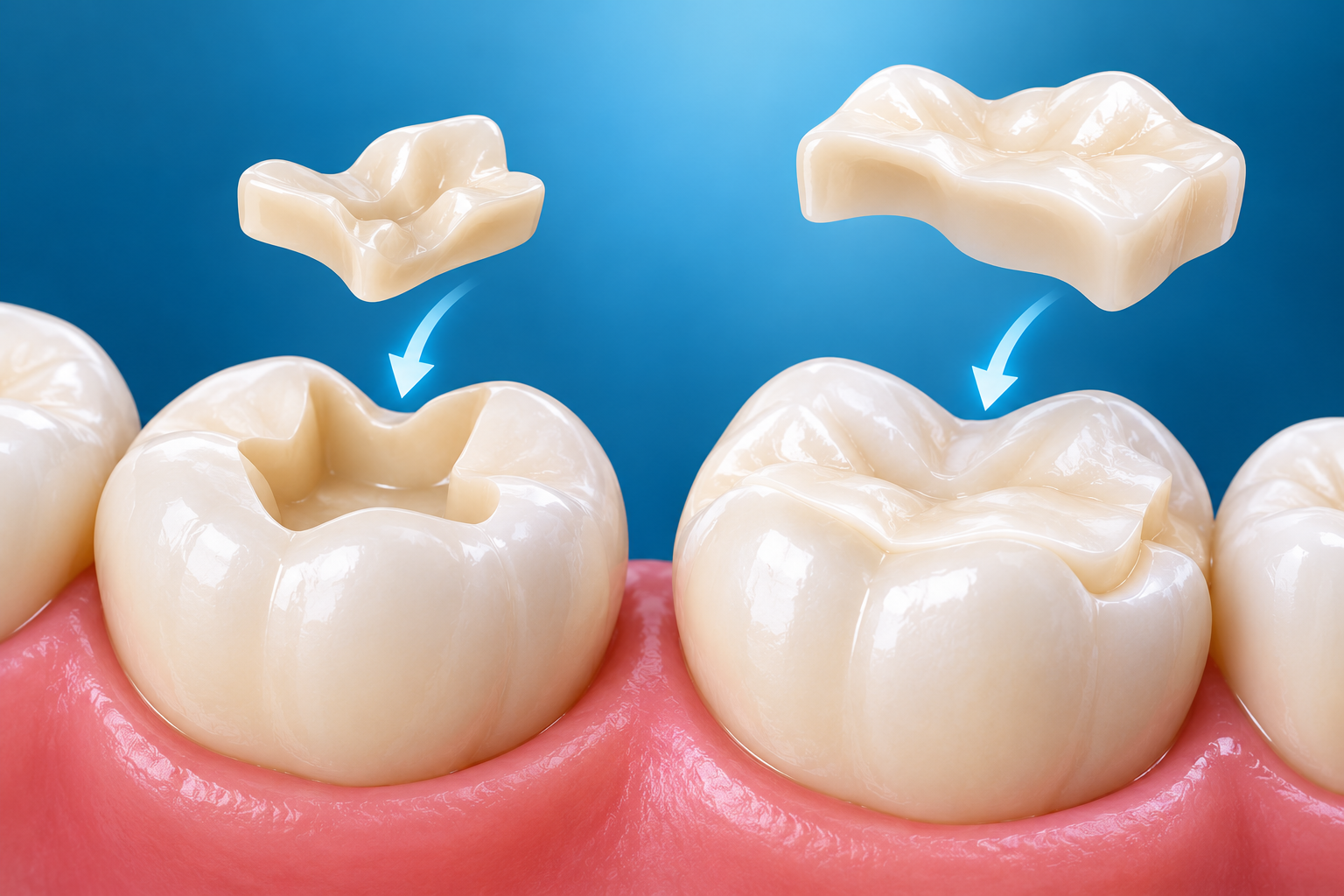
An onlay is sometimes described as a partial crown, because it covers more of the tooth than an inlay but still far less than a full crown. Your dentist chooses between the two based on exactly how much healthy tooth remains and which parts need protecting. Both are made and fitted in the same way, and the choice is a clinical judgement made after examining the tooth and reviewing an X-ray.
How Is This Different from an Ordinary Filling?
A filling is built up and set inside the tooth in one visit. An inlay or onlay is made in a laboratory and bonded in at a second visit. The lab-made restoration fits more precisely, resists wear better, and is stronger for larger cavities, where a big direct filling would be more likely to crack or leak over time.
For small to moderate cavities, a direct white filling is the right choice: it is quick, effective and conserves tooth structure. The picture changes when the cavity is large. A very big direct filling has to withstand heavy biting forces across a wide area, and over time large fillings are more prone to cracking, leaking at the edges, and allowing decay to creep back underneath. This is where an indirect restoration performs better.
Research supports this distinction. Laboratory-made restorations show better marginal adaptation, which means a tighter seal at the edges, and studies have reported less microleakage and less post-operative sensitivity than large direct composite fillings. In practical terms, for a large restoration an inlay or onlay tends to last longer and protect the tooth more reliably than an equally large filling. If your tooth is suitable for a simpler repair, your dentist will always tell you, and you can read more about routine repairs on our dental fillings page.
When Is a Restoration Chosen Instead of a Crown?
An inlay or onlay is chosen when enough healthy tooth remains that a full crown would remove more than necessary. A crown caps the entire tooth, which means grinding it down all around. An onlay rebuilds only the damaged part, preserving more of your natural tooth, which is better for the tooth’s long-term health.
There is a natural ladder of tooth restoration, moving from the most conservative option to the most extensive. A filling repairs small damage. An inlay or onlay repairs larger damage while keeping most of the tooth. A crown is used when so much tooth is lost or weakened that the whole tooth needs capping for protection. Wherever possible, keeping more of your own tooth is the better long-term outcome, because every millimetre of healthy natural tooth removed is gone permanently.
A crown requires the tooth to be reduced on all sides to make room for the cap. An onlay, by contrast, removes only the damaged tissue and rebuilds that part alone. For a tooth that has a strong, healthy foundation but a cracked or broken cusp, an onlay is often the more tooth-preserving choice. Where a tooth genuinely needs full coverage, a crown remains the correct treatment, and you can read about that option on our dental crowns page.
The table below sets out how the four main restorations compare:
| Restoration | How Much It Covers | How It Is Made | Typically Used For |
|---|---|---|---|
| Filling | Small area within the tooth | Placed and set in the mouth, one visit | Small to moderate cavities |
| Inlay | Central biting surface, between the cusps | Made in a laboratory, bonded in | Larger cavities where cusps are intact |
| Onlay | Central surface plus one or more cusps | Made in a laboratory, bonded in | Damaged or cracked cusps, weakened teeth |
| Crown | The entire tooth, all surfaces | Made in a laboratory, cemented over the tooth | Heavily broken down or root-treated teeth |
Why Might Your Dentist Recommend This for Your Tooth?
Your dentist may recommend an inlay or onlay when a large old filling has failed, when a cavity is too big to fill reliably, or when a cusp has cracked or weakened. In each case the tooth needs more than a filling can offer, but still has enough healthy structure to avoid a full crown.
The most common reasons this treatment is recommended include:
- A large filling has failed. Old or extensive fillings eventually crack, leak, or fall out. Replacing a large failed filling with another large filling often repeats the problem, whereas an inlay or onlay provides a stronger, better-sealed repair.
- The cavity is too big for a filling. When decay has removed a significant amount of tooth, a direct filling may not have enough sound tooth to bond to reliably, making a lab-made restoration the more durable choice.
- A cusp is cracked or weakened. If one of the raised points of the tooth is fractured or undermined, an onlay covers and protects it, holding the tooth together and reducing the risk of a larger break.
- You want to preserve the tooth. Where a crown would mean removing healthy tooth unnecessarily, an inlay or onlay conserves more of your natural tooth.
In some cases, where decay has reached the nerve of the tooth, your dentist may first carry out root canal treatment, after which an onlay can restore and protect the tooth while preserving more structure than a crown.
Your dentist confirms the recommendation after a clinical examination and an X-ray, which shows the extent of the damage beneath the surface. A dental examination is the starting point for identifying whether this treatment is right for your tooth.
What Are They Made From, and Which Material Is Best?
Inlays and onlays can be made from tooth-coloured ceramic or porcelain, composite resin, or gold. Ceramic and porcelain are the most popular because they are strong and match the natural tooth colour closely. Gold is exceptionally durable but visible. Your dentist recommends the most suitable material for your tooth and bite.
Each material has its own balance of strength and appearance:
- Ceramic and porcelain are hard-wearing and blend in with the surrounding teeth, making them almost invisible. They are the most widely chosen option for back teeth where both strength and a natural look matter.
- Composite resin is tooth-coloured and slightly less costly than ceramic. It offers good aesthetics and can be a suitable choice in the right situation, though it is generally less hard-wearing than ceramic.
- Gold is extremely strong and long-lasting and is gentle on the opposing teeth. Its obvious drawback is appearance, so it is now chosen far less often, though some patients still prefer it for its durability on back teeth.
There is no single best material for everyone. The right choice depends on which tooth is being restored, how much force it takes when you bite, how visible it is, and your own preference. Your dentist will talk through the options with you and recommend the material best suited to your tooth before any treatment begins.
What Happens During the Two Appointments?
At the first appointment, your dentist numbs the tooth, removes the decay or old filling, and takes a digital scan. A temporary restoration protects the tooth while a laboratory makes your inlay or onlay, usually over one to two weeks. At the second appointment, the finished restoration is checked and bonded permanently into place.
Here is the process step by step at One Two Three Dental in Guiseley:
- Preparation. The tooth is numbed with local anaesthetic, and your dentist removes any decay or the old failed filling, leaving a clean, sound foundation for the restoration.
- Scan or impression. A precise digital scan, or an impression, is taken of the prepared tooth. This is what the laboratory uses to make a restoration that fits exactly.
- Temporary protection. A temporary restoration is placed to protect the tooth and keep you comfortable while the permanent one is made, which typically takes one to two weeks.
- Fitting and bonding. At the second visit, the temporary is removed and your dentist checks the fit, the bite, and the appearance of the finished restoration before bonding it firmly in place with adhesive resin cement.
Some practices offer same-day inlays and onlays using in-house milling technology, which removes the need for a temporary and a second visit. Where two appointments are used, the short wait allows a specialist laboratory to craft the restoration to a high standard.
Will It Hurt, and What Is Recovery Like?
No. The tooth is fully numbed with local anaesthetic, so the procedure itself is painless. Afterwards, some mild sensitivity to hot and cold for a few days is normal and settles on its own. There is no significant recovery period, and you can return to normal activities straight away.
The preparation and fitting are carried out under local anaesthetic, so you should feel only pressure and movement, not pain. If you ever feel discomfort during treatment, your dentist can give more anaesthetic, and you should never be expected to continue through pain.
After the anaesthetic wears off, it is common to notice some mild sensitivity in the tooth, particularly to temperature, for a few days. This is a normal part of healing and usually resolves without any treatment. Once the permanent restoration is bonded, the tooth functions normally and you can eat and drink as usual, taking a little care until any short-lived sensitivity has settled. For patients who feel anxious about dental treatment, our nervous patient team is experienced in making appointments calm and comfortable.
How Long Do They Last?
With good care, inlays and onlays are long-lasting restorations, and onlays in particular can last many years. Longevity depends on the material, the tooth, your bite, and your oral hygiene. When they do eventually fail, the usual causes are fracture of the material, the restoration coming loose, or new decay at the edges.
Inlays and onlays are durable restorations, and clinical studies have shown ceramic and composite versions perform comparably to or better than large direct fillings over the long term for suitably sized restorations. Well-made ceramic restorations in particular have shown high survival rates in research spanning many years, and gold restorations are recognised for exceptional durability. The exact lifespan varies from person to person.
Several factors influence how long a restoration lasts. Good daily oral hygiene protects the edges from new decay, which studies identify as a common reason for eventual failure alongside fracture of the material and debonding. Heavy grinding or clenching places extra force on the restoration, and habits such as chewing very hard objects can shorten its life. Attending routine check-ups allows your dentist to monitor the restoration and catch any problem early, which is the single best way to get the longest life from it.
What Do These Restorations Cost in the UK?
Private inlays and onlays in the UK typically range from around £300 to £800 depending on the material and the complexity of the tooth, with gold restorations sometimes higher. On the NHS they fall under Band 3, charged at £332.10 in England from April 2026. The exact cost at One Two Three Dental is confirmed after your assessment.
The cost depends mainly on the material chosen and the complexity of the individual tooth. As a general guide to UK private fees, composite restorations tend to sit at the lower end of the range, ceramic and porcelain in the middle, and gold at the higher end owing to the material itself. The tooth being treated and the amount of preparation involved also affect the final figure.
On the NHS, inlays and onlays are included in Band 3 treatment, which is charged at £332.10 in England from April 2026, though access to NHS appointments varies by area. At One Two Three Dental, all costs are explained and confirmed before treatment begins in line with our Fair Price Charter, with no hidden charges. Patients on our membership plan receive a discounted rate, and 0% finance options are available to spread the cost into manageable monthly payments.
How Do You Look After a Restored Tooth?
Care for a tooth with an inlay or onlay exactly as you would a natural tooth. Brush twice a day, clean between your teeth daily, and keep up routine dental check-ups. Avoid biting very hard objects, and if you grind your teeth, ask your dentist about a protective night guard to prolong the restoration’s life.
A restored tooth does not need special products, but it does benefit from consistent good habits. Brushing twice daily with fluoride toothpaste and cleaning between the teeth keeps the edges of the restoration free of plaque, which is where new decay would otherwise start. This everyday care directly protects the seal that keeps the restoration sound.
A few sensible precautions help the restoration last. Avoid using your teeth to bite very hard items such as ice or pen lids, which can fracture the material. If you grind or clench your teeth, whether during the day or in your sleep, the added force can shorten the life of any restoration, and a custom night guard can protect it. Keeping up regular check-ups lets your dentist review the restoration and address any early issue before it becomes a larger problem.
Why Choose One Two Three Dental in Guiseley for This Treatment?
At One Two Three Dental in Guiseley, inlays and onlays are provided as part of a tooth-preserving approach to restoration, using precise digital scans and quality laboratory work. We explain clearly why a particular restoration suits your tooth, discuss the material options, and confirm all costs in advance under our Fair Price Charter.
Our approach begins with conserving as much of your natural tooth as possible. Rather than reaching for the most extensive treatment, we recommend the option that protects your tooth while removing the least healthy structure, which for many teeth means an inlay or onlay rather than a crown. We take the time to explain the findings from your examination and X-ray so you understand exactly why a particular restoration is being recommended.
Every treatment is discussed fully before it begins, including the material choice and the cost, so there are no surprises. For anyone who feels nervous about dental care, we provide a calm, unhurried experience and additional support where it is needed. All costs are confirmed in advance under our Fair Price Charter, with finance options available to spread the cost.
Book a Restoration Consultation in Guiseley
If you have a large failed filling, a cracked tooth, or have been told you may need a crown, an inlay or onlay could be a more tooth-preserving option worth exploring. Contact our Guiseley team to book an assessment, and we will examine the tooth and explain the most suitable way to restore it.
If you are unsure whether your tooth needs this treatment, a dental examination is the right first step. Your dentist will assess the tooth, take an X-ray where needed, and talk you through the options, including the likely cost and how finance can help spread it.